
 Daniel Frutiger
Many leaders are great in one setting but fail in another. Often, the problem is not a lack of hard work. It is a style problem. Think of leadership like the gears in a car. If you try to drive on a fast highway using only first gear, you will burn out the engine. Leadership works the same way. If you only use one style for every task, you will burn out your team.
Modern executive and leadership coaching teaches you how to change gears on purpose. When you learn to switch styles based on the needs of your team, you become more effective. You stop reacting and start leading with intent. This article breaks down the six styles of leadership and shows you how to use them in real life.
The Six Styles in Executive and Leadership Coaching
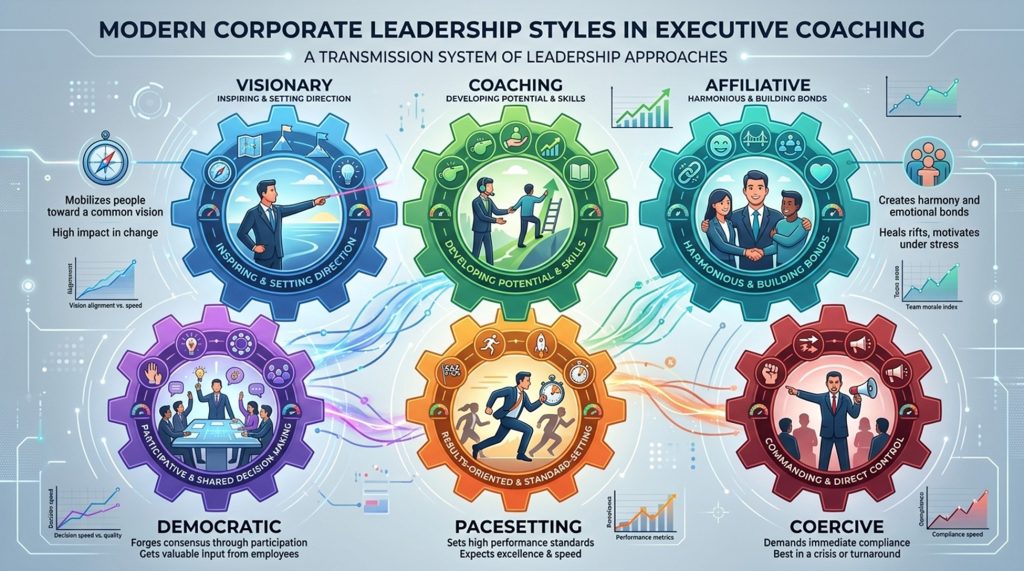
Success comes from knowing which gear to use at the right time. Here are the six personas you need to master. Small business owners often find that business coaching provides the clarity needed to choose the right gear.
1. The Visionary (Authoritative)
The Visionary says, "Follow me." This style is best when your team is lost or when a big change is coming. It provides a "North Star" for everyone to look at. You give the team a clear goal, but you let them choose how to get there.
- When to use it: When you need a new strategy or a clear focus.
- When to avoid it: When you have not decided on the destination yet.
- What to say: "Our goal is to keep our customers happy. Every task should lead to that. Here is where we are going, but you choose how we get there."
2. The Coach (Coaching)
The Coach says, "Grow with me." This is a long-term style. It is about building skills, not just checking off tasks. This is a core part of executive and leadership coaching because it focuses on the future of the person.
- When to use it: When you have time to help people improve their skills.
- When to avoid it: When a deadline is minutes away.
- What to say: "What is one skill that would change your game this week? Let us look at how you plan your work and sharpen those muscles."
3. The Affiliative (People First)
This style is about trust and bond building. It puts people before tasks. It is vital when morale is low or after a team goes through a hard time, like a layoff or a big reorganization.
- When to use it: When the team is stressed or after a conflict.
- When to avoid it: When work quality is dropping and you need to be firm.
- What to say: "How are you doing, really? What is one way I can support you this week?"
4. The Democratic (Participative)
The Democratic leader asks, "What do you think?" This style builds buy-in. When people feel heard, they are more likely to support a decision. It helps you see risks you might have missed.
- When to use it: Before a big launch or when you need fresh ideas.
- When to avoid it: In an emergency when you need to move fast.
- What to say: "Tell me your top concern in one sentence. What risk are we not seeing yet?" You can practice these questions during a leadership intensive at our upcoming events.
5. The Pacesetter (Performance)
The Pacesetter says, "Watch me and keep up." This gear is for high speed and high bars. It works best for short bursts with a team that already knows what they are doing.
- When to use it: During a final push at the end of a quarter.
- When to avoid it: With a new team or when people are tired.
- What to say: "The gold standard is this. Let us hit this goal by Friday. I will clear any blocks in your way today."
6. The Coercive (Commanding)
This style says, "Do what I say." It often gets a bad reputation, but it is necessary in a true crisis. It is about safety and following the law.
- When to use it: During a security leak or a safety emergency.
- When to avoid it: Almost any other time. It kills trust if used too much.
What to say: "For safety and legal reasons, we are doing this now. I will explain why later."

Combining Styles for Better Results
In the real world, you rarely use just one gear. You stack them. Effective executive and leadership coaching helps you learn these combinations. Our corporate training helps leaders stack these styles to improve workplace culture.
Crisis Management via Coercive, Visionary, and Affiliative Styles
When things go wrong, you need to stabilize the situation first.
- Coercive: Take control to stop the damage.
- Visionary: Give the team a new direction so they feel safe.
- Affiliative: Check in on how people are feeling to rebuild trust.
New Strategy Launching via Visionary, Democratic, and Coaching Styles
Starting something new requires a mix of vision and teamwork.
- Visionary: Set the big goal.
- Democratic: Ask the team for their ideas on how to reach it.
- Coaching: Help people learn the new skills they need to win.
Fixing Burnout via Affiliative, Coaching, and Visionary Approaches
If your team is exhausted, you cannot just tell them to work harder.
- Affiliative: Show that you care about them as humans.
- Coaching: Help them manage their load and build better habits.
- Visionary: Remind them why the work matters in the first place.
Find Your Default and Your Growth Edge
Every leader has a "default" gear. This is the style you use when you are stressed or not thinking about it. To find yours, look back at your last tough week. How did you talk to your team? If you gave orders, your default might be Coercive or Pacesetting. If you spent the whole time listening, it might be Affiliative.
Your "growth edge" is the style you use the least. This is where you need to stretch. If you are always a Visionary, try being Democratic. Ask, "What am I missing?" If you are always a Pacesetter, try being Affiliative. Ask, "How are you really doing?"
Borrowing just one sentence from your growth edge can change the energy of your team. You do not have to be perfect at every style. You just need to have more than one gear in your toolkit. You can refine your leadership skills through personalized leadership coaching sessions.
Frequently Asked Questions
What is the most effective leadership style?
There is no single best style. The most effective leaders are those who can change their style to fit the situation. A crisis needs a different approach than a brainstorming session.
Can I learn new leadership styles?
Yes. Leadership is a set of skills, not something you are born with. Through practice and coaching, you can learn to use styles that do not feel natural to you at first.
How do I know which style to use?
Look at your team and the task. Is the team new? Use Coaching. Is there a deadline in an hour? Use Pacesetting. Is morale low? Use Affiliative.
Why is Pacesetting dangerous?
Pacesetting can lead to burnout if used for too long. It sets a very high bar and expects everyone to keep up without much help. It should only be used for short periods.
What is the difference between Coaching and Mentoring?
Coaching is often about asking questions to help a person find their own answers and build skills. Mentoring is usually about giving advice based on your own past experiences.
How does the Democratic style save time in the long run?
While it takes longer to make a decision when you ask everyone for input, it saves time later. When people help make the plan, they are more committed to making it work, which means fewer problems during the execution.
Is the Coercive style always bad?
No. In a situation involving safety or legal rules, you need to give direct orders. The danger is using this style for regular daily work, which makes people stop thinking for themselves.
How can I practice my growth edge?
Pick one meeting this week. Choose one sentence from a style you rarely use. Write it down and say it during the meeting. See how your team reacts. Small steps build new habits.